
About
I-Ching Oracle
This site is a contemplative digital I-Ching practice. It is not built around prediction. It is built around the older use of the Book of Changes as a mirror for timing, conduct, relationship, and the forces already moving in a situation.
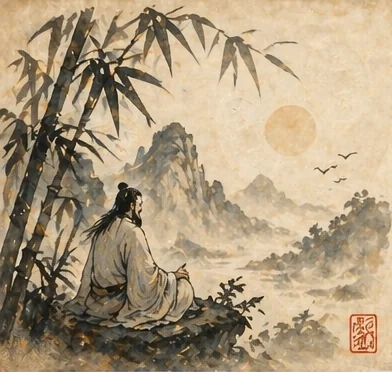
A Reflective Companion
The site brings together classical hexagram structure, original commentary, short parables, and illustrated sequences so that the oracle can be studied as well as consulted. The aim is not to flatten the Book of Changes into quick certainty, but to give its movements a form that is easier to revisit.
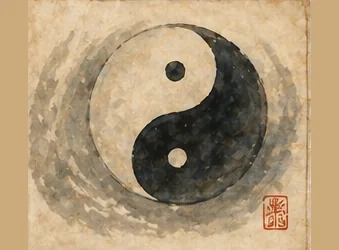 Change
Yin and yang are read as movements, not fixed labels.
Change
Yin and yang are read as movements, not fixed labels.
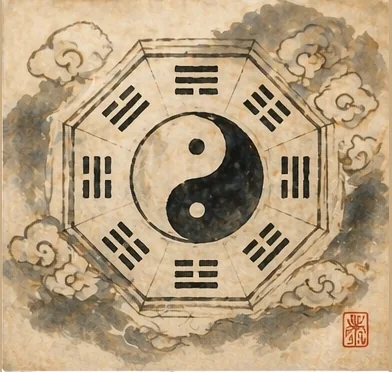 Structure
Trigrams, six lines, and the King Wen order give the reading its frame.
Structure
Trigrams, six lines, and the King Wen order give the reading its frame.
 Practice
Daily pages, cast readings, and quiet return matter more than prediction.
Practice
Daily pages, cast readings, and quiet return matter more than prediction.
Editorial Note
Written as one body of work
This site is published under the I-Ching Daily signature rather than a personal byline. The commentary, daily reflections, line summaries, and illustrated parables are composed as one interpretive project rather than assembled from scraped fragments, anonymous excerpts, or generic SEO copy.
The aim is not to replace classical translations. It is to offer a coherent contemporary companion: one editorial voice, one method of reading, and a visual form that makes return, comparison, and reflection easier over time.
Research, interpretation, and final editorial judgment are kept inside that single line of curation. Production tools may assist with layout, illustration preparation, and publishing workflow, but the readings are presented as a deliberately edited body of work, not an automated content feed.
Written and curated under the I-Ching Daily signature.
- Original commentary and daily reflections
- Illustrated six-panel parables for every hexagram
- Contemporary reading guidance grounded in classical structure
- Published under one editorial signature rather than an anonymous content network
- Classical structure and translations are used as reference points, not copied wholesale
- Production tools may assist the workflow, but final wording and selection are curated for this site
- Not a replacement for classical translations
- Not a prediction engine promising certainty
- Not an anonymous content mill dressed as divination
Illustrated Parables
Each of the 64 hexagrams includes an original short story and six illustrated panels that turn the hexagram's lesson into a visual sequence.
Classical Structure
The readings follow the King Wen order, eight trigrams, six lines, changing lines, and relating hexagram logic. The commentary is original and contemporary, not a critical edition of a classical translation.
Daily and Personal Practice
The daily archive gives each date a permanent hexagram page. Personal readings can be cast with coins or yarrow probabilities, then kept by saving a PDF, downloading a share card, or copying a share link.
Books In The Library
The reading tools already built around the site
The oracle is the centre of the project, but the current library already extends it in four different directions: family stories, journaling, interpretation training, and the full illustrated oracle.
Story-led family edition
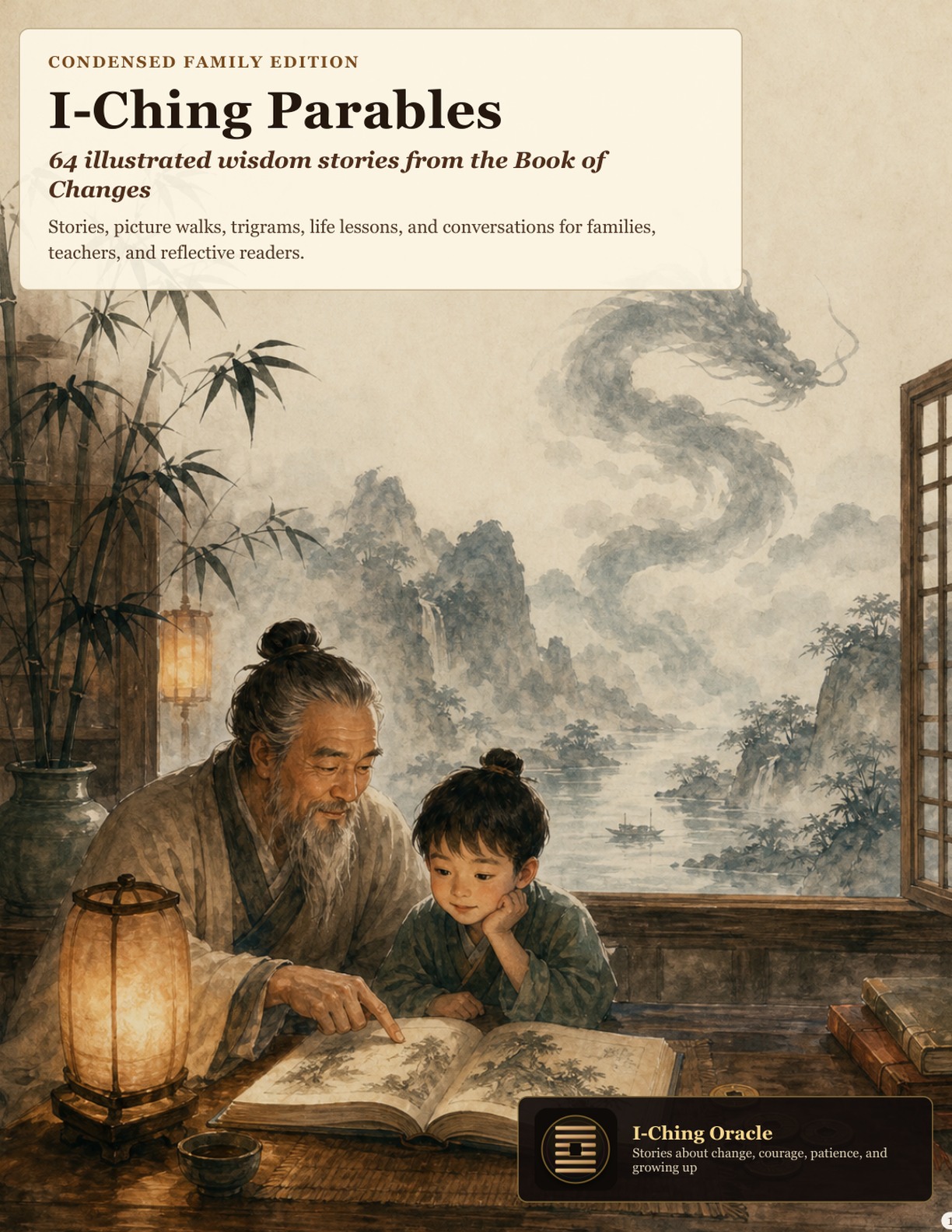
I-Ching Parables
The gentler illustrated family edition for shared reading, classrooms, and first contact with the 64 hexagrams through story.
Record the reading
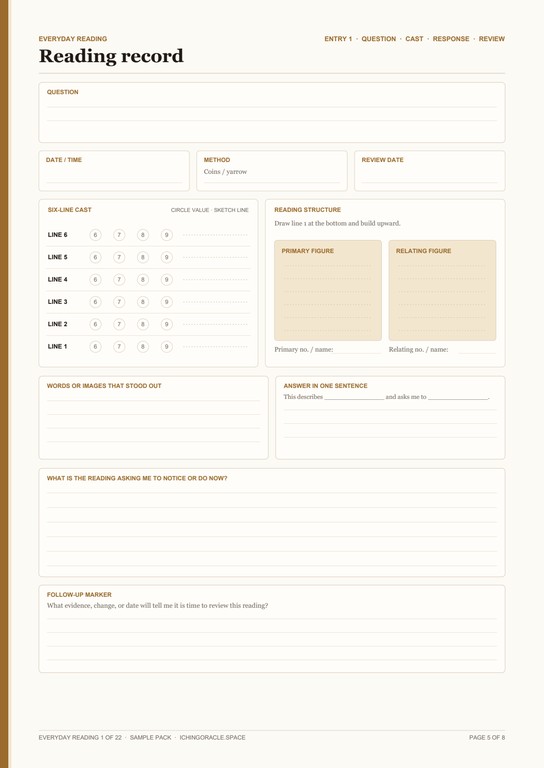
I Ching Reading Journal PDF
A print-first journal for recording the cast structure, first interpretation, and later outcome instead of relying on memory alone.
Interpret change
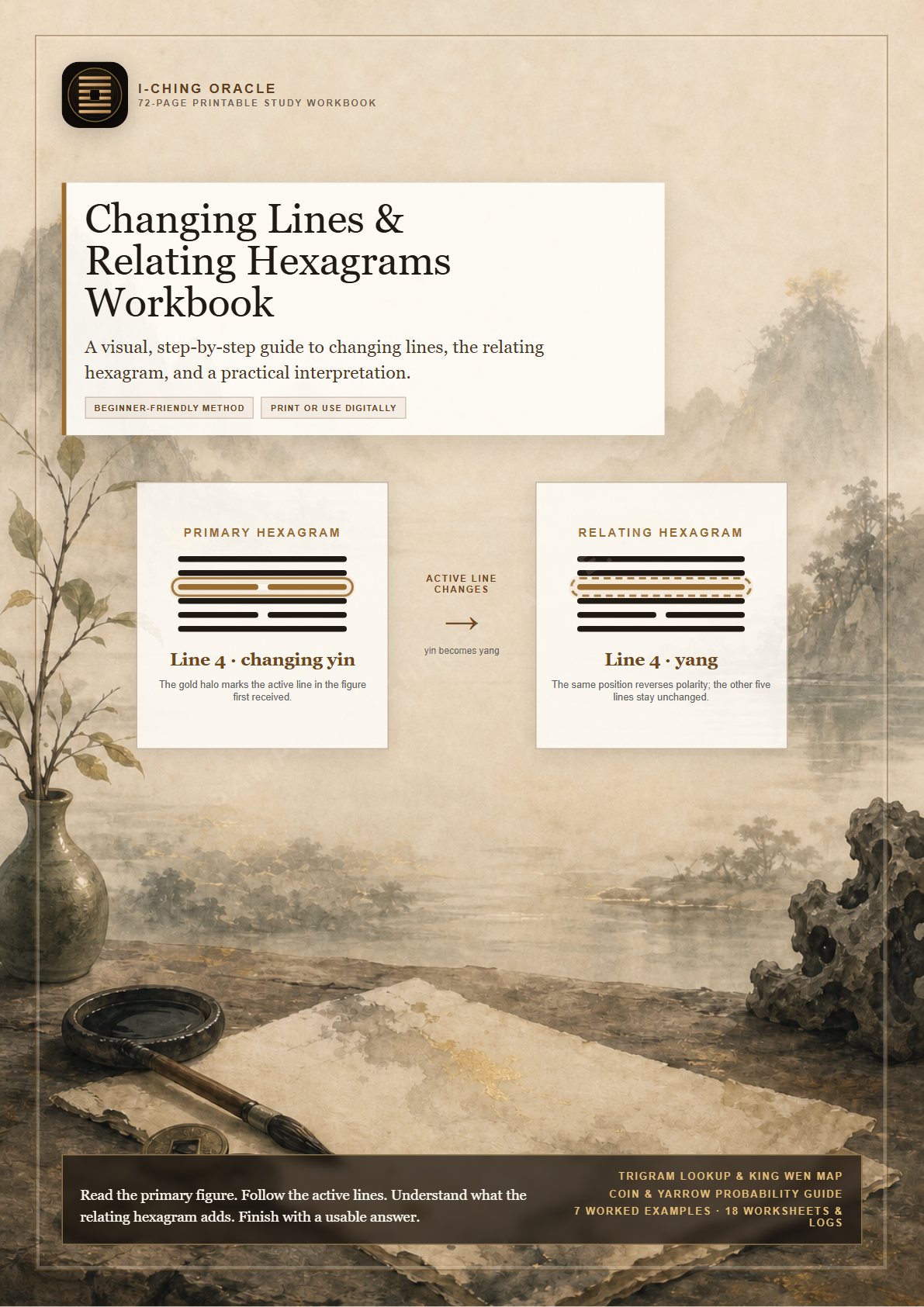
Changing Lines & Relating Hexagrams Workbook
The focused workbook for the point where moving lines appear and the reading becomes dynamic but harder to weigh correctly.
Full illustrated oracle
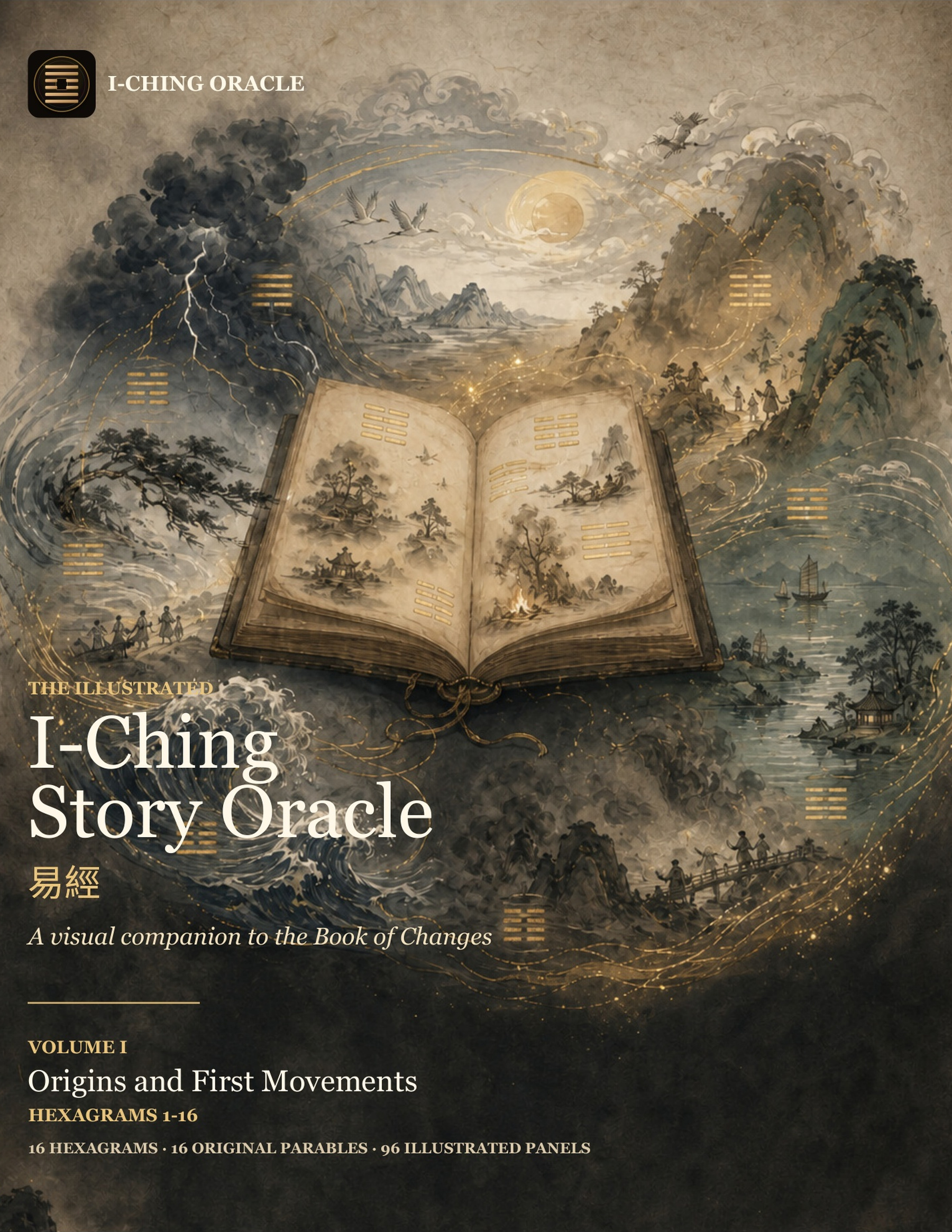
The Illustrated I-Ching Story Oracle
The long-form showpiece edition that keeps the formal text, line voices, original parables, and the illustrated panel sequence together.
How to Read This Site
- Start with the daily hexagram when you want the general weather of the day.
- Cast a personal reading when you have a specific situation or question.
- Use the stories and images as reflective aids, not as fixed fortune-telling answers.
- Check Sources & Method for the casting probabilities, privacy model, and interpretive limits.
Trust, Policies, and Support
Support
Membership sign-in issues, billing questions, and saved-reading help all flow through the support page and support email.
Privacy
The privacy page explains what stays in the browser, what membership stores, and which providers handle authentication, hosting, and billing.
Terms
The terms page covers reflective-use limits, membership access, reasonable site use, and the boundaries of the service.