
I-Ching Hexagram 10
履 Treading
Also known as Conduct
Hexagram 10, Treading, appears when the situation requires precise conduct rather than force. The reading favors tact, cheerful steadiness, and awareness of danger while moving through sensitive terrain.
treading · conduct · tact
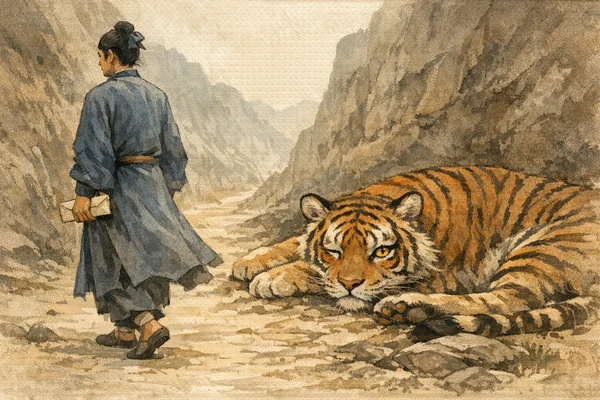 One Open Eye
Core Meaning
Judgment and image
The Judgment
Treading upon the tail of the tiger. It does not bite the man. Success.
The Image
Heaven above, the lake below: the image of treading. Thus the superior person discriminates between high and low, and thereby fortifies the thinking of the people.
The Six Lines
This list mirrors the figure from top (Sixth) to bottom (First). For interpretation, read from the bottom line upward. Each line shows a different stage of the hexagram's movement.
Look to your conduct and weigh the favorable signs. When everything is fulfilled, supreme good fortune comes. Review the path walked; if it is whole, great fortune follows.
Resolute conduct. Perseverance with awareness of danger. Firmness is needed, but eyes wide open — not impulsive courage.
He treads on the tail of the tiger. Caution and circumspection lead ultimately to good fortune. Even in real danger, careful conduct prevails.
A one-eyed man is able to see, a lame man is able to tread. He treads on the tail of the tiger. The tiger bites the man. Misfortune. A warrior acts thus for his great prince. Overreach by the under-equipped; only genuine capacity earns the position.
Treading a smooth, level course. The perseverance of a dark man brings good fortune. Stay on the even path; flashy moves are not needed.
Simple conduct. Progress without blame. Go about ordinary life in ordinary clothes; no affectation.
Interpretation and trigrams
Interpretation
Walking carefully on dangerous ground. The figure is about conduct in charged situations — around power, around risk, among people of higher station. Tact, timing, and a cheerful steadiness carry you through what force would ruin.
Trigrams
The Story
A messenger had to cross a pass where a tiger slept across the trail. His companions said to turn back; his commission said to go on. He took off his bells. He took off his sword. He walked past the tiger with his eyes on the horizon, breathing like the wind through grass. The tiger opened an eye, watched him pass, and closed it. At the next village he delivered his letter and said nothing of the tiger. Tact is not fear. Tact is the discipline of acting as though nothing is in one's way, while knowing precisely what is.
Why This Story Fits
The parable is written to make Hexagram 10 visible as lived conduct: Walking carefully on dangerous ground. It echoes the Image's counsel: the superior person discriminates between high and low, and thereby fortifies the thinking of the people. Lower trigram: Lake. Upper trigram: Heaven. Together they set the story's inner and outer weather.
Quick Meaning
What Hexagram 10 means
Hexagram 10 describes treading carefully where the ground is real but dangerous. It appears in questions about conduct under pressure: around power, risk, strong personalities, or unequal footing. The reading favors tact, self-command, and a cheerful steadiness that moves through danger without provoking it unnecessarily.
- It supports careful conduct where force or carelessness would trigger trouble.
- It favors tact, timing, and awareness of rank, consequence, and context.
- It warns against overreach, swagger, and stepping beyond actual capacity.
When this hexagram appears
- The situation is sensitive. You may be close to power, danger, or a person who cannot be handled casually.
- Conduct is the answer. Hexagram 10 often appears when the key issue is not what you want but how you are moving, speaking, and placing yourself.
- Steadiness outranks bravado. Success comes from precise behavior and inner poise, not from proving courage by pushing too far.
How to apply Treading
In relationships
Move with tact when emotions, history, or imbalance make the space charged. The reading favors careful speech and clear self-command over reactive confrontation.
In work or decisions
Respect the terrain. This may be a question of hierarchy, reputation, or risk. Advance carefully, know the limits, and do not act bigger than your real footing allows.
In personal growth
Practice conduct that can remain composed in exposed or testing conditions. This hexagram supports building a reliable way of moving through pressure without becoming stiff or boastful.
Use Hexagram 10 in context
Hexagram 10 FAQ
Does Treading mean the situation is dangerous?
Often yes, or at least sensitive. The danger may be literal, social, emotional, or political. The point is that conduct matters enough to change the outcome.
Why does this hexagram focus so much on behavior?
Because in charged situations, behavior is not superficial. Tone, timing, and self-command determine whether the tiger bites or lets you pass.
What if Hexagram 10 has changing lines?
Changing lines show where conduct is simple and sound, where overreach brings harm, or where firm movement succeeds only because it remains fully aware of danger.
Mobile app
Take the oracle with you
Cast with coins or yarrow, read the daily hexagram, browse all 64 hexagrams, and keep private reading notes on your device.

Available now on the App Store and Google Play.