
I-Ching Hexagram 18
蠱 Work on the Decayed
Also known as Correcting Corruption
Hexagram 18, Work on the Decayed, appears when something has been left to rot and can no longer be ignored. The reading favors diagnosis, repair, and the courage to correct what has been passed down in damaged form.
decay · repair · inherited work
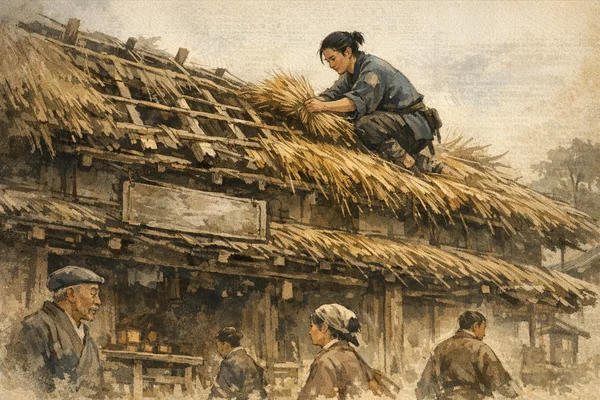 Re-Thatching Himself
Core Meaning
Judgment and image
The Judgment
Supreme success. It furthers one to cross the great water. Before the starting point, three days. After the starting point, three days.
The Image
The wind blows low on the mountain: the image of decay. Thus the superior person stirs up the people and strengthens their spirit.
The Six Lines
This list mirrors the figure from top (Sixth) to bottom (First). For interpretation, read from the bottom line upward. Each line shows a different stage of the hexagram's movement.
He does not serve kings and princes. Sets himself higher goals. To withdraw from public work in order to pursue the inner task — honoured when it is real.
Setting right what has been spoiled by the father. One meets with praise. Repair done with skill earns recognition.
Tolerating what has been spoiled by the father. In continuing one sees humiliation. Postponing the work is itself a form of rot.
Setting right what has been spoiled by the father. There will be a little remorse. No great blame. Vigorous repair leaves some bruises; acceptable.
Setting right what has been spoiled by the mother. One must not be too persevering. Repair with feeling; do not let correctness override love.
Setting right what has been spoiled by the father. If there is a son, no blame rests upon the departed father. Danger. In the end good fortune. Repairing an inheritance honours rather than accuses its source.
Interpretation and trigrams
Interpretation
Something has been rotting — often something inherited. The hexagram names the work of repair: diagnosing corruption, undoing what has gone stale, renewing the foundations. Reflect carefully before and after the turning point; true repair is a campaign, not a single blow.
Trigrams
The Story
A grown son returned to his father's inn and found the roof sagging, the accounts falsified by an old steward, the regular guests drifting away. He did not curse his father's memory. He re-thatched the roof himself. He sat down with the steward and went through the books line by line, pardoning small thefts and dismissing him quietly for the large one. Slowly the inn returned. When his own son inherited it, he told him: "To honor a father is sometimes to repair what he could not. Do it without shame — his, or yours."
Why This Story Fits
The parable is written to make Hexagram 18 visible as lived conduct: Something has been rotting — often something inherited. It echoes the Image's counsel: the superior person stirs up the people and strengthens their spirit. Lower trigram: Wind. Upper trigram: Mountain. Together they set the story's inner and outer weather.
Quick Meaning
What Hexagram 18 means
Hexagram 18 describes repair: the work of confronting corruption, clearing decay, and renewing what has been damaged through neglect or inheritance. It appears when something spoiled can no longer be worked around. The reading favors diagnosis, courage, and sustained correction, and warns that delay, sentimentality, or surface treatment will only deepen the rot.
- It supports honest repair, disciplined correction, and the renewal of foundations that have been compromised over time.
- It favors careful reflection before and after the turning point, because real repair is a sequence of work rather than one dramatic strike.
- It warns against postponement, inherited denial, and confusing loyalty to the past with refusal to correct what the past has spoiled.
When this hexagram appears
- Something old is affecting the present. The issue may be structural, familial, institutional, or psychological, but it has roots that reach back before the current moment.
- Repair requires diagnosis. Hexagram 18 often appears when you must understand the nature of the corruption before trying to fix it, otherwise the same pattern will return under a new surface.
- Delay is part of the problem. The reading favors timely correction, because what is tolerated out of convenience or reluctance will continue to spread.
How to apply Work on the Decayed
In relationships
Name what has been festering instead of circling it. The reading favors repair that is honest, proportionate, and rooted in care, not blame disguised as truth-telling.
In work or decisions
Go to the failing process, not just the visible symptom. This is a strong time to audit, restore standards, and take on unglamorous maintenance that prevents a larger breakdown later.
In personal growth
Examine inherited habits, assumptions, and unfinished material. Hexagram 18 supports deep corrective work, especially where you are ready to stop reenacting an old pattern and actually repair it.
Use Hexagram 18 in context
Hexagram 18 FAQ
Does Work on the Decayed mean something has gone badly wrong?
It means something neglected or inherited needs correction. That can be serious, but the hexagram is fundamentally constructive: it appears when repair is both possible and necessary.
Why does the text mention what has been spoiled by the father or the mother?
Because this hexagram often concerns what has been passed down. The issue may come through family, tradition, leadership, or prior decisions that still shape the present.
What if Hexagram 18 has changing lines?
Changing lines show whether repair must be firm, tender, delayed no longer, publicly recognised, or redirected away from outer service toward deeper inner correction.
Mobile app
Take the oracle with you
Cast with coins or yarrow, read the daily hexagram, browse all 64 hexagrams, and keep private reading notes on your device.

Available now on the App Store and Google Play.