
I-Ching Hexagram 20
觀 Contemplation
Also known as View
Hexagram 20, Contemplation, appears when the question calls for vision before action. The reading favors surveying the whole field, examining your own life honestly, and understanding that people are already learning from how you stand.
contemplation · observing · example
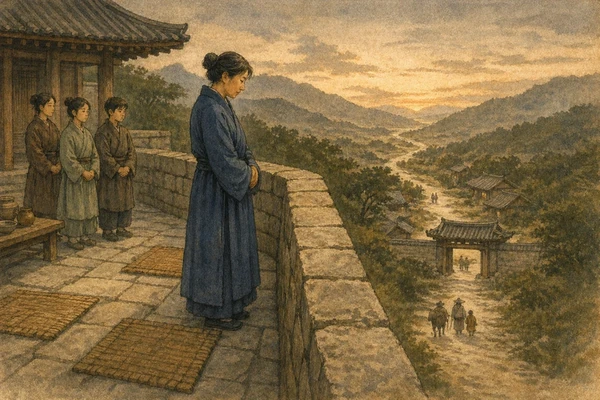 At The Temple Wall
Core Meaning
Judgment and image
The Judgment
The ablution has been made, but not yet the offering. Full of trust they look up to him.
The Image
The wind blows over the earth: the image of contemplation. Thus the kings of old visited the regions of the world, contemplated the people, and gave them instruction.
The Six Lines
This list mirrors the figure from top (Sixth) to bottom (First). For interpretation, read from the bottom line upward. Each line shows a different stage of the hexagram's movement.
Contemplation of his life. The superior person is without blame. Detached perspective on one's whole course — a wisdom that others feel.
Contemplation of my life. The superior person is without blame. Examine one's own life with unsparing honesty.
Contemplation of the light of the kingdom. It furthers one to exert influence as the guest of a king. See clearly into public life; act as counsellor, not claimant.
Contemplation of my life decides the choice between advance and retreat. Honest self-appraisal is the hinge.
Contemplation through the crack of the door. Furthering for the perseverance of a woman. A partial view is enough for the private sphere but not for wider action.
Boy-like contemplation. For an inferior person, no blame. For a superior person, humiliation. A child may see simply; a leader must see deeper.
Interpretation and trigrams
Interpretation
The figure of the observer — and of being observed. It concerns vision: seeing widely and truly, and recognising that one's own conduct is a teaching whether one intends it or not. Before acting, survey. Before reforming others, become an example worth watching.
Trigrams
The Story
A teacher stood each evening at the temple wall and watched the road below. Her students thought she was looking for someone. Asked at last, she said: "I am watching how people walk when they do not know they are seen. That is where their character lives." She gave no sermons; she adjusted her own conduct by what she saw, and her students, watching her, adjusted theirs. A whole valley was slowly reformed without a single lecture. To contemplate is not to withdraw from the world — it is to become the kind of silent presence that teaches by being watched.
Why This Story Fits
The parable is written to make Hexagram 20 visible as lived conduct: The figure of the observer — and of being observed. It echoes the Image's counsel: the kings of old visited the regions of the world, contemplated the people, and gave them instruction. Lower trigram: Earth. Upper trigram: Wind. Together they set the story's inner and outer weather.
Quick Meaning
What Hexagram 20 means
Hexagram 20 describes contemplation: seeing the whole field clearly, understanding that your conduct is already being observed, and letting vision precede intervention. It appears when the real task is not immediate action but wide perception, self-examination, and becoming a trustworthy example. The reading favors survey, perspective, and instruction that arises from what you embody rather than what you merely say.
- It supports broad observation, honest self-study, and taking in the shape of events before trying to move them.
- It favors example over pressure, perspective over haste, and influence that comes from clear presence rather than assertion.
- It warns against partial seeing, premature judgment, and trying to reform others before examining your own life and stance.
When this hexagram appears
- The situation needs surveying. There may be too much movement, emotion, or complexity for a narrow first impression to be reliable.
- You are part of what is being seen. Hexagram 20 often appears when your example, tone, or presence teaches more than your declared intent.
- Clear sight comes before useful action. The reading favors stepping back far enough to see the pattern, then acting from that understanding rather than from reaction.
How to apply Contemplation
In relationships
Watch the whole relational field instead of only the latest exchange. The reading favors seeing what your own behavior teaches and what the other person is actually responding to.
In work or decisions
Survey before directing. This is a strong time to gather perspective, study the real conditions, and act as a clear-eyed counselor rather than a hurried claimant.
In personal growth
Examine your life as if it were already instructing others. Hexagram 20 supports sober reflection, integrity of example, and the humility to see where your vision is still partial.
Use Hexagram 20 in context
Hexagram 20 FAQ
Does Contemplation mean doing nothing?
No. It means seeing first. The hexagram favors a pause that increases accuracy and authority, not passivity or avoidance.
Why does this hexagram stress being looked up to?
Because contemplation here is mutual: you observe the world, but the world is also reading you. The quality of your example becomes part of the answer.
What if Hexagram 20 has changing lines?
Changing lines show whether the vision is childish, partial, self-reflective, publicly discerning, unsparingly honest, or broad enough to comprehend a whole life from above.
Mobile app
Take the oracle with you
Cast with coins or yarrow, read the daily hexagram, browse all 64 hexagrams, and keep private reading notes on your device.

Available now on the App Store and Google Play.