
I-Ching Hexagram 22
賁 Grace
Also known as Adornment
Beauty of form. The hexagram affirms the dignity of ornament, manner, ritual — the refined surfaces of life — while warning that appearance cannot substitute for substance in matters of real weight.
grace · adornment · form
 One Balanced Character
Core Meaning
Judgment and image
The Judgment
Success. In small matters it is favorable to undertake something.
The Image
Fire at the foot of the mountain: the image of grace. Thus does the superior person proceed when clearing up current affairs. But they do not dare to decide controversial issues in this way.
The Six Lines
This list mirrors the figure from top (Sixth) to bottom (First). For interpretation, read from the bottom line upward. Each line shows a different stage of the hexagram's movement.
Simple grace. No blame. Utter plainness at the summit; the ornament stripped, the form vindicated.
Grace in hills and gardens. The bundle of silk is meager and small. Humiliation, but in the end good fortune. Unpretentious generosity — awkward to give, but rightly received.
Grace or simplicity? A white horse comes as if on wings. He is not a robber, he will woo at the right time. A moment of honest plainness; the sincere suitor comes openly.
Graceful and moist. Constant perseverance brings good fortune. Rich surface, sustained by inner substance.
Lends grace to the beard on his chin. Ornament that is merely accessory — harmless, not essential.
He lends grace to his toes, leaves the carriage, and walks. Refusal of empty display; going on foot with one's principles intact.
Interpretation and trigrams
Interpretation
Beauty of form. The hexagram affirms the dignity of ornament, manner, ritual — the refined surfaces of life — while warning that appearance cannot substitute for substance in matters of real weight. Grace is appropriate to small matters; great decisions demand unadorned truth.
Trigrams
The Story
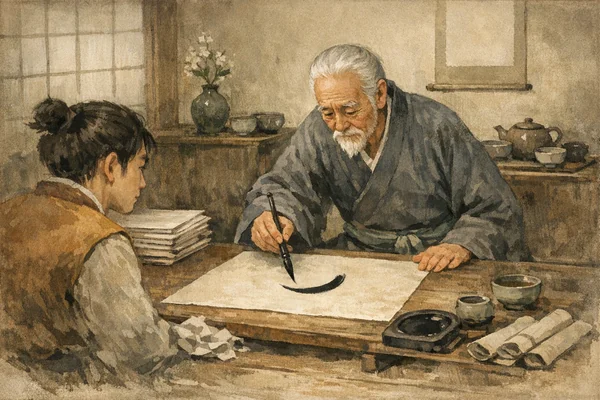
A calligrapher took three days to choose the paper for a single character. His student thought this extravagant. The master wrote the character — small, balanced, breath-steady — and hung it in his tea room. A visiting general, seeing it, bought every scroll in the shop and paid triple for the one in the tea room. But the master would not sell that one. "Grace is the surface of a discipline," he told his student, "and it only matters when the discipline is real. Learn the stroke first. Then the paper will know you."
Why This Story Fits
The parable is written to make Hexagram 22 visible as lived conduct: Beauty of form. It echoes the Image's counsel: the superior person proceeds by clearing up current affairs. Lower trigram: Fire. Upper trigram: Mountain. Together they set the story's inner and outer weather.
Quick Meaning
What Hexagram 22 means
Hexagram 22 describes grace: the beauty of form, manners, ritual, and outward refinement. It appears when presentation matters, but also when there is danger in letting surface treatment stand in for substance. The reading favors elegance in small matters, careful finishing, and forms that honor what is real, while warning against using appearance to decide what requires deeper truth.
- It supports refinement, good form, and small acts of beauty that bring order, dignity, or gentleness to the situation.
- It favors polishing what is already true, using fitting ceremony, and knowing when grace helps something land well.
- It warns against decoration replacing substance, style disguising weakness, and making major decisions on the basis of appearances.
When this hexagram appears
- Form needs attention. The issue may not be the core itself, but how it is being presented, carried, or completed.
- Small matters can be improved beautifully. Hexagram 22 often appears when tone, finish, courtesy, or visual order can genuinely help.
- Major truths should stay undecorated. The reading says grace has a proper scale. It assists small matters, but controversial or weighty matters demand plain seeing.
How to apply Grace
In relationships
Let care show in tone, courtesy, and detail. The reading favors tenderness of form, but not using charm to avoid what still needs to be said plainly.
In work or decisions
Polish the presentation, not the truth. This is a strong time to improve clarity, design, and finish, while keeping major judgments grounded in substance rather than style.
In personal growth
Cultivate outer grace as an expression of inner order. Hexagram 22 supports modest beauty, disciplined refinement, and learning where form serves truth rather than replaces it.
Use Hexagram 22 in context
Hexagram 22 FAQ
Does Grace mean appearance is more important than truth?
No. It means form matters, but only in its place. Grace can dignify or clarify what is true; it becomes dangerous when it begins to replace what is true.
Why does the Judgment limit Grace to small matters?
Because beauty and presentation help with finishing, courtesy, and atmosphere, but they are not enough to resolve large, controversial, or foundational questions.
What if Hexagram 22 has changing lines?
Changing lines show whether grace is modest, accessory, richly grounded, honest in simplicity, awkward but sincere, or ultimately stripped down to the plain form that needs no ornament.
Mobile app
Take the oracle with you
Cast with coins or yarrow, read the daily hexagram, browse all 64 hexagrams, and keep private reading notes on your device.

Available now on the App Store and Google Play.