
I-Ching Hexagram 28
大過 Preponderance of the Great
Also known as Critical Mass
A structure loaded beyond its capacity — strong in the middle, weak at the ends. The hexagram demands decisive action: either reinforce the weak points or accept a fundamental change.
critical mass · excess · overload
 Sagging Ridgepole
Core Meaning
Judgment and image
The Judgment
The ridgepole sags to the breaking point. It furthers one to have somewhere to go. Success.
The Image
The lake rises above the trees: the image of preponderance of the great. Thus the superior person, when they stand alone, is unconcerned, and if they have to renounce the world, they are undaunted.
The Six Lines
This list mirrors the figure from top (Sixth) to bottom (First). For interpretation, read from the bottom line upward. Each line shows a different stage of the hexagram's movement.
One must go through the water. It goes over one's head. Misfortune. No blame. Doing what is right at the cost of one's own loss; catastrophic, but not shameful.
A withered poplar puts forth flowers. An older woman takes a husband. No blame. No praise. Revival is partial and cosmetic; no harm done, but no renewal either.
The ridgepole is braced. Good fortune. If there are ulterior motives, it is humiliating. Proper reinforcement succeeds; but do not use the repair for private gain.
The ridgepole sags to the breaking point. Misfortune. Stubborn loading at the centre; the structure fails.
A dry poplar sprouts at the root. An older man takes a young wife. Everything furthers. Unexpected renewal where it was not expected.
To spread white rushes underneath. No blame. Extreme caution with a delicate, important task; soft padding beneath a heavy load.
Interpretation and trigrams
Interpretation
A structure loaded beyond its capacity — strong in the middle, weak at the ends. The hexagram demands decisive action: either reinforce the weak points or accept a fundamental change. This is not a moment for ordinary measures, and the person of character may have to stand alone.
Trigrams
The Story
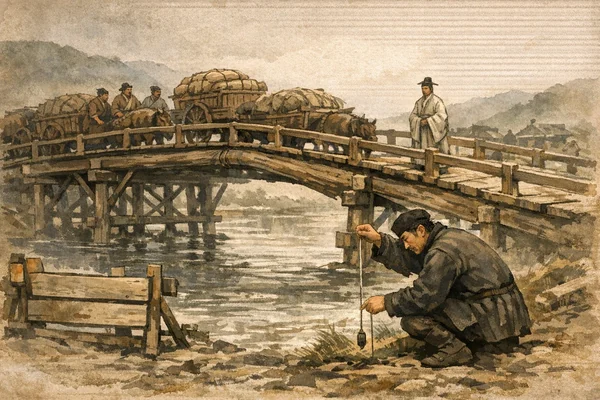
A bridge carried the trade of the province, but its ridgepole had begun to sag under loads it had never been built for. The engineer could see that ordinary repair would not hold; the whole spine needed rebuilding, and the road would have to close for a season. The merchants protested. The magistrate hesitated. The engineer shouldered the cost himself and rebuilt it in three months. A season of loss; forty more years of trade. Critical mass asks for critical action. A patched ridgepole collapses; only the one willing to stand alone rebuilds.
Why This Story Fits
The parable is written to make Hexagram 28 visible as lived conduct: A structure loaded beyond its capacity — strong in the middle, weak at the ends. It echoes the Image's counsel: the superior person, when they stand alone, is unconcerned, and if they have to renounce the world, they are undaunted. Lower trigram: Wind. Upper trigram: Lake. Together they set the story's inner and outer weather.
Quick Meaning
What Hexagram 28 means
Hexagram 28 describes a structure carrying more weight than its frame can safely bear. It appears when the strain is already visible, when ordinary maintenance is no longer enough, and when a bold reinforcement, decisive change, or solitary stand is required. The reading supports strong corrective action and inner steadiness, but it warns against pretending the load is normal or delaying until the structure fails on its own.
- It supports decisive reinforcement, necessary overhaul, and the courage to act before visible strain turns into collapse.
- It favors honest recognition that the old frame cannot carry the present burden without real change.
- It warns against cosmetic fixes, wishful delay, and leaving a failing structure in place out of convenience or fear.
When this hexagram appears
- The load is exceeding the support. The core issue is not simply pressure, but pressure on a form that can no longer hold it safely.
- Ordinary measures will not do. Hexagram 28 often appears when small repairs, polite delay, or incremental adjustment are no longer proportionate to the problem.
- Someone may need to stand alone. The reading favors clear perception, decisive action, and the willingness to carry responsibility when consensus is too timid or late.
How to apply Preponderance of the Great
In relationships
Do not ignore the strain points. The reading favors honest acknowledgment of what the bond is carrying and decisive repair before resentment or exhaustion hardens into damage.
In work or decisions
Act at the structural level, not just the symptom level. This is a strong time to reinforce, redesign, or close a failing arrangement before the load does it for you.
In personal growth
Notice where your life is asking more than your present form can bear. Hexagram 28 supports strong adjustment, deeper support, and the courage to change the frame instead of merely enduring.
Use Hexagram 28 in context
Hexagram 28 FAQ
Does Hexagram 28 always mean collapse?
No. It means the structure is overburdened. Collapse is possible if the strain is ignored, but the figure itself favors decisive correction before failure becomes inevitable.
Why does the Judgment say it furthers one to have somewhere to go?
Because this is not a time to sit passively inside a failing arrangement. The reading favors movement toward a real solution, even if that requires a bold change of direction.
What if Hexagram 28 has changing lines?
Changing lines show where the overload is slight or critical, where support is still possible, and whether the answer lies in reinforcement, decisive action, or accepting that the old form must give way.
Mobile app
Take the oracle with you
Cast with coins or yarrow, read the daily hexagram, browse all 64 hexagrams, and keep private reading notes on your device.

Available now on the App Store and Google Play.