
I-Ching Hexagram 27
頤 Nourishment
Also known as Mouth Corners
The jaws of the mouth, the channel of sustenance. The figure concerns what goes in and what comes out — food, words, influences.
nourishment · jaws · sustenance
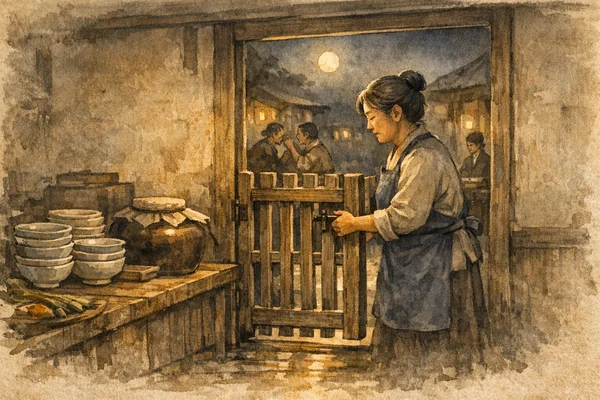 Guard The Gate
Core Meaning
Judgment and image
The Judgment
Perseverance brings good fortune. Pay attention to providing nourishment and to what a person seeks to fill their own mouth with.
The Image
At the foot of the mountain, thunder: the image of providing nourishment. Thus the superior person is careful of their words and temperate in eating and drinking.
The Six Lines
This list mirrors the figure from top (Sixth) to bottom (First). For interpretation, read from the bottom line upward. Each line shows a different stage of the hexagram's movement.
The source of nourishment. Awareness of danger brings good fortune. It furthers one to cross the great water. Those who feed others bear responsibility; but with care, the great works succeed.
Turning away from the path. To remain persevering brings good fortune. One should not cross the great water. Stay home and cultivate rather than launch new ventures; not the moment for bold moves.
Turning to the summit for provision of nourishment brings good fortune. Spying about with sharp eyes like a tiger with insatiable craving. No blame. Turning upward is correct here; reach purposefully toward worthy nourishment.
Turning away from nourishment. Perseverance brings misfortune. Do not act thus for ten years. Nothing serves to further. A refusal of real sustenance; a long time before recovery.
Turning to the summit for nourishment, deviating from the path to seek nourishment from the hill. Continuing to do this brings misfortune. Looking in the wrong direction for sustenance; the corruption deepens with habit.
You let your magic tortoise go and look at me with the corners of your mouth drooping. Misfortune. Envying another's nourishment while your own is abandoned.
Interpretation and trigrams
Interpretation
The jaws of the mouth, the channel of sustenance. The figure concerns what goes in and what comes out — food, words, influences. It asks: are you nourishing yourself, and those around you, with what truly sustains?
Trigrams
The Story
A cook ran a small kitchen at the edge of a market. She was particular about what she bought, slow with what she prepared, and exact about what she served. She refused to sell to those who ate while arguing. "The food enters you," she said. "It becomes your thoughts. I will not sell thoughts to a fool." Her kitchen was always full. A scholar from the capital, observing her, wrote: "What is taken in, one becomes. Guard the mouth — for both food and speech — as you would guard a gate into the self."
Why This Story Fits
The parable is written to make Hexagram 27 visible as lived conduct: The jaws of the mouth, the channel of sustenance. It echoes the Image's counsel: the superior person is careful of their words and temperate in eating and drinking. Lower trigram: Thunder. Upper trigram: Mountain. Together they set the story's inner and outer weather.
Quick Meaning
What Hexagram 27 means
Hexagram 27 describes nourishment: what enters the mouth, what leaves it, and what a life is fed by over time. It appears when attention should turn toward sustenance, speech, appetite, influence, and the daily habits that either strengthen or weaken the character. The reading supports careful feeding and careful speaking, but it warns that people become like what they consume, repeat, and justify.
- It supports good nourishment in the broad sense: food, ideas, speech, company, rhythm, and the influences that quietly shape the inner life.
- It favors conscious intake, measured expression, and choosing what truly feeds growth instead of what merely satisfies craving.
- It warns against sloppy appetite, manipulative speech, and building a life around what drains, agitates, or hollows you out.
When this hexagram appears
- The question is not only what you want. It is also what you are taking in, what you are repeating, and what your daily habits are feeding.
- Speech is part of nourishment. Hexagram 27 often appears when words are either strengthening the situation or quietly poisoning it.
- Small choices accumulate. The reading favors modest correction in diet, influence, pacing, and expression rather than dramatic declarations detached from daily practice.
How to apply Nourishment
In relationships
Ask what the bond is being fed by. Hexagram 27 favors honest, sustaining exchange and warns against relationships held together by appetite, flattery, resentment, or emotional junk food.
In work or decisions
Strengthen the inputs before pushing the output. This is a good time to improve information, training, routine, and communication so the work is supported at the root.
In personal growth
Notice what you feed yourself every day. Hexagram 27 supports disciplined care, cleaner influences, and speech that builds structure instead of scattering force.
Use Hexagram 27 in context
Hexagram 27 FAQ
Does nourishment only refer to food?
No. The figure includes food, but it also concerns speech, attention, influence, education, company, and the emotional and intellectual diet you live on every day.
Why is speech so important in Hexagram 27?
Because what leaves the mouth feeds the situation just as surely as what enters it. Words can steady, sustain, distort, tempt, flatter, or starve trust.
What if Hexagram 27 has changing lines?
Changing lines show where appetite is clean or distorted, where support is real or dependent, and how nourishment becomes either strengthening discipline or restless consumption.
Mobile app
Take the oracle with you
Cast with coins or yarrow, read the daily hexagram, browse all 64 hexagrams, and keep private reading notes on your device.

Available now on the App Store and Google Play.