
I-Ching Hexagram 4
蒙 Youthful Folly
Also known as Inexperience
Hexagram 4, Youthful Folly, appears when there is real potential but not yet clear understanding. The reading favors humble learning, steady discipline, and questions asked from genuine need rather than impatience.
learning · teaching · inexperience
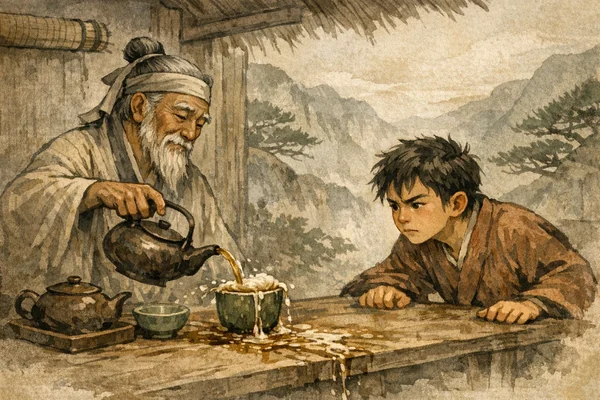 Cup Overflowing
Core Meaning
Judgment and image
The Judgment
Success. It is not I who seek the young fool; the young fool seeks me. At the first oracle I answer; if he asks two or three times, it is importunity. To importunity I give no answer. Perseverance furthers.
The Image
A spring wells up at the foot of a mountain: the image of youth. Thus the superior person fosters their character by thoroughness in all they do.
The Six Lines
This list mirrors the figure from top (Sixth) to bottom (First). For interpretation, read from the bottom line upward. Each line shows a different stage of the hexagram's movement.
In punishing folly it does not further one to commit transgressions. Only to prevent transgressions furthers. Discipline is for correction, not cruelty; apply it with the minimum necessary force.
Childlike folly brings good fortune. Innocence of heart, even when unknowing, opens the way; the humble learner is teachable.
Entangled folly brings humiliation. The beginner wraps themselves in their own confusions; only reality will unwind them.
Take not a maiden who, seeing a man of bronze, loses possession of herself. Nothing furthers. Do not attach to what dazzles; impressionability at the wrong moment is costly.
To bear with fools in kindness brings good fortune. To know how to take women brings good fortune. The son is capable of taking charge of the household. Patience with imperfection; the learner grows inside a tolerant structure.
To make a fool develop, it furthers one to apply discipline. Fetters should be removed. To go on thus brings humiliation. Correction at the outset — but then release, so the lesson can live.
Interpretation and trigrams
Interpretation
The beginner's position — much potential, little knowledge. The figure is about teaching and learning: the pupil must come with sincere need; the teacher must not repeat themselves when the question is posed lazily. Progress comes from discipline and small, thorough habits, not grand gestures.
Trigrams
The Story
A boy came to the mountain sage and asked the meaning of wisdom. The sage gave a short answer. The boy did not listen and asked again. The sage poured tea until the cup overflowed. The boy asked a third time. The sage carried the cup outside to the spring that ran from beneath the mountain rock, emptied it onto the stones, and placed the empty cup under the falling water. "The first question was sincere," said the sage. "The second was habit. The third came before the first answer had settled." The boy watched the cup fill drop by drop, then fetched wood in silence for a year. When he asked again, the sage answered — and this time the boy heard. The spring runs beneath the mountain; only the sincere cup carries water away.
Why This Story Fits
The parable is written to make Hexagram 4 visible as lived conduct: The beginner's position — much potential, little knowledge. It echoes the Image's counsel: the superior person fosters their character by thoroughness in all they do. Lower trigram: Water. Upper trigram: Mountain. Together they set the story's inner and outer weather.
Quick Meaning
What Hexagram 4 means
Hexagram 4 describes beginner confusion that can become wisdom. It does not criticize not-knowing; it asks how you meet not-knowing. The figure favors sincere inquiry, clear instruction, and disciplined practice over restless repetition or fascination with quick answers.
- It supports honest learning and patient correction at the beginning of a path.
- It favors questions that arise from real need, not nervous repetition.
- It warns against being dazzled, stubbornly tangled, or unwilling to practice what has already been shown.
When this hexagram appears
- You are at a genuine learning edge. The situation contains possibility, but you do not yet fully understand the ground, the timing, or the right response.
- The quality of the question matters. Hexagram 4 distinguishes sincere inquiry from importunity. It answers the learner, not the person demanding certainty on command.
- Growth comes through small thoroughness. The lesson is rarely dramatic. It is usually built through discipline, repetition, and willingness to be corrected.
How to apply Youthful Folly
In relationships
Do not pretend to know what you do not know. Ask clean questions, listen carefully, and resist impulsive reactions. This hexagram often asks for teachability and maturity rather than instant certainty.
In work or decisions
Slow down enough to learn the structure. Seek guidance where needed, take the first correction seriously, and do not keep asking for answers you have not yet applied.
In personal growth
Be willing to be a beginner without becoming careless. The reading supports humility, practice, and the kind of discipline that slowly turns inexperience into real character.
Use Hexagram 4 in context
Hexagram 4 FAQ
Does Youthful Folly mean I am doing everything wrong?
No. It means you are still learning. The problem is not inexperience itself, but refusing correction, demanding certainty too quickly, or staying tangled after guidance has already been given.
Why does this hexagram warn against repeated questioning?
Because repeating the question can become a way of avoiding practice. Hexagram 4 favors receiving the first clear answer, then working with it honestly before asking again.
What if Hexagram 4 has changing lines?
Changing lines show where the learner is becoming teachable or remaining entangled. In this hexagram they often distinguish clean correction from humiliation caused by impressionability, confusion, or refusal to learn.
Mobile app
Take the oracle with you
Cast with coins or yarrow, read the daily hexagram, browse all 64 hexagrams, and keep private reading notes on your device.

Available now on the App Store and Google Play.