
I-Ching Hexagram 3
屯 Difficulty at the Beginning
Also known as Sprouting
Hexagram 3, Difficulty at the Beginning, appears when something real is trying to begin but the conditions are still tangled. It asks for patience, support, and careful ordering of what is not yet stable.
birth pangs · chaos · sprouting
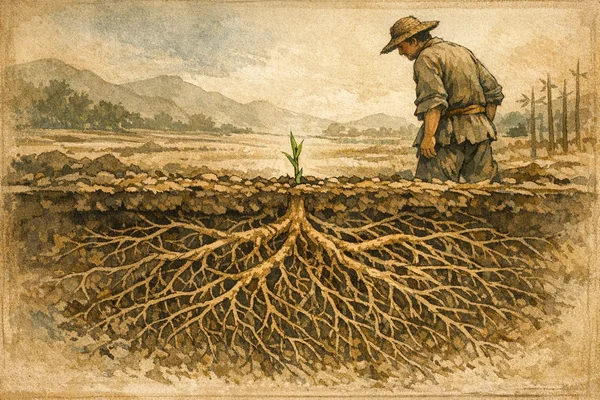 Unseen Roots
Core Meaning
Judgment and image
The Judgment
Supreme success, furthering through perseverance. Do not undertake anything. It furthers one to appoint helpers.
The Image
Clouds and thunder: the image of difficulty at the beginning. Thus the superior person brings order out of confusion.
The Six Lines
This list mirrors the figure from top (Sixth) to bottom (First). For interpretation, read from the bottom line upward. Each line shows a different stage of the hexagram's movement.
Horse and wagon part. Bloody tears flow. When one cannot find the way, grief is the only thing left; withdraw and grieve cleanly rather than flail.
Difficulty in blessing. A little perseverance brings good fortune. Great perseverance brings misfortune. Even good things can be spoiled by overreach.
Horse and wagon part. Strive for union. To go brings good fortune. Everything acts to further. Accept help when it is offered; do not insist on going alone.
One hunts stag without the forester, only losing one's way in the forest. The superior person understands the signs and stops. Without a guide the ground is unknowable; pressing on is folly.
Difficulties pile up. Horse and wagon part. She is not a robber; he wants to woo her when the time comes. Wait ten years; then things come right. Distinguish real obstacles from apparent ones; patience restores what haste would spoil.
Hesitation and hindrance. It furthers one to remain persevering. It furthers one to appoint helpers. Do not force; build the support first.
Interpretation and trigrams
Interpretation
A shoot pushing through hard ground. The situation is pregnant with promise but tangled — too early to charge ahead, too consequential to drift. The counsel is to organise: gather allies, sort what is load-bearing from what is noise, and let the initiative find its natural stems before pruning.
Trigrams
The Story
A bamboo seed slept three years beneath the soil. The farmer came each spring and found only dirt. On the fourth spring a pale green tip broke through, and within three months the stalk was taller than a man. The farmer, who had almost given up, understood: the shoot had spent those silent years growing roots. Without that tangled, unseen labor, the first strong wind would have laid it flat. What looks like nothing happening is often everything being prepared. Do not force the sprout; strengthen the root, gather helpers, and wait for the season that will not break you.
Why This Story Fits
The parable is written to make Hexagram 3 visible as lived conduct: A shoot pushing through hard ground. It echoes the Image's counsel: the superior person brings order out of confusion. Lower trigram: Thunder. Upper trigram: Water. Together they set the story's inner and outer weather.
Quick Meaning
What Hexagram 3 means
Hexagram 3 describes a real beginning under pressure. Growth is present, but it is not yet orderly. The situation is alive, confused, and vulnerable, and it favors patience, structure, and the right helpers rather than speed.
- It supports careful beginnings that are protected while they are still fragile.
- It favors gathering support, sorting confusion, and making the first workable order.
- It warns against forcing early results before the conditions can carry them.
When this hexagram appears
- A beginning is real, but not settled. The new thing has life in it, yet the surrounding conditions are still disordered or immature.
- Confusion is part of the stage. The reading does not mean the start is wrong; it means the start needs support, rhythm, and room to organize itself.
- The first job is not expansion. It is to establish enough order that the beginning can survive its own early instability.
How to apply Difficulty at the Beginning
In relationships
A bond may be trying to form, repair, or restart, but it is still awkward and uncertain. Move gently, set simple expectations, and protect what is promising without demanding immediate clarity.
In work or decisions
Prioritize setup, sequencing, and allies. A project at this stage needs infrastructure more than acceleration. Choose the next workable step, not the most ambitious one.
In personal growth
Do not despise the messy beginning. New habits, roles, and inner clarity often arrive in fragments. Your task is to protect the emerging pattern until it can carry itself.
Use Hexagram 3 in context
Hexagram 3 FAQ
Does Difficulty at the Beginning mean the start is doomed?
No. It means the beginning is real but immature. The pressure belongs to the stage itself. The answer is usually better structure, pacing, and support, not abandonment.
Why does this hexagram emphasize helpers and order?
Because new growth is easily overwhelmed by confusion. Hexagram 3 often appears when the right assistance, sequencing, or leadership matters more than raw determination.
What if Hexagram 3 has changing lines?
Changing lines show where the beginning is finding traction or running into trouble. In this hexagram they often distinguish healthy early effort from forcing, scattering, or trusting the wrong support.
Mobile app
Take the oracle with you
Cast with coins or yarrow, read the daily hexagram, browse all 64 hexagrams, and keep private reading notes on your device.

Available now on the App Store and Google Play.