
I-Ching Hexagram 48
井 The Well
Also known as Source
Hexagram 48, The Well, appears when the question turns on foundations, shared resources, and whether the source is being kept usable. The reading favors maintenance, clear access, and completing the work that allows nourishment to reach people.
well · source · nourishment
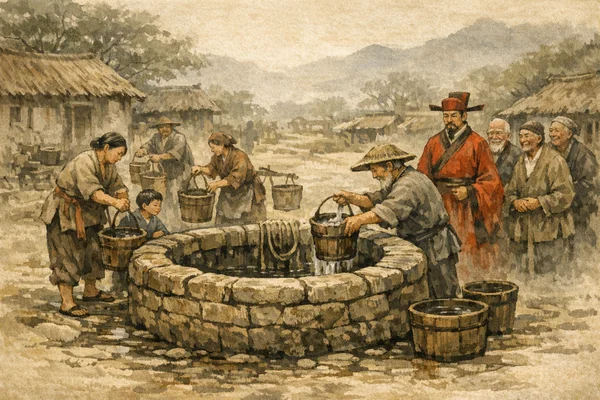 Old Shared Well
Core Meaning
Judgment and image
The Judgment
The town may be changed, but the well cannot be changed. It neither decreases nor increases. They come and go and draw from the well. If one gets down almost to the water and the rope does not go all the way, or the jug breaks, it brings misfortune.
The Image
Water over wood: the image of the well. Thus the superior person encourages the people at their work, and exhorts them to help one another.
The Six Lines
This list mirrors the figure from top (Sixth) to bottom (First). For interpretation, read from the bottom line upward. Each line shows a different stage of the hexagram's movement.
One draws from the well without hindrance. It is dependable. Supreme good fortune. The ideal state: a well that serves all without limit.
In the well there is a clear, cold spring from which one can drink. The source is revealed; share it.
The well is being lined. No blame. Repairing the foundations — no immediate yield, but essential.
The well is cleaned, but no one drinks from it. This is my heart's sorrow, for one might draw from it. If the king were clear-minded, good fortune might be enjoyed in common. Talent available but not recognised; the loss is everyone's.
At the well hole one shoots fishes. The jug is broken and leaks. Fine resources wasted through careless containers.
One does not drink the mud of the well. No animals come to an old well. A neglected well; neglect deepens until none come at all.
Interpretation and trigrams
Interpretation
A well serves all who come to it — a figure of the deep, shared source that civilisation is built on. The hexagram counsels attention to foundations: keep the well clear, do the work of maintenance, and see that nothing goes half-done. A broken jug at the surface wastes the whole journey down.
Trigrams
The Story
A village well was so old that no one remembered who had dug it. Every generation cleaned it; every family drew from it; no one owned it. A proud new magistrate proposed taxing the water; the elders laughed, and the proposal died. "The well does not belong to us," the oldest farmer said. "We belong to it." When the village's boundaries shifted, when the dynasty changed, when the road moved, the well remained. Certain things in a society are not property. They are the shared source — and the health of a place is measured by whether the source is kept clear.
Why This Story Fits
The parable is written to make Hexagram 48 visible as lived conduct: A well serves all who come to it — a figure of the deep, shared source that civilisation is built on. It echoes the Image's counsel: the superior person encourages the people at their work, and exhorts them to help one another. Lower trigram: Wind. Upper trigram: Water. Together they set the story's inner and outer weather.
Quick Meaning
What Hexagram 48 means
Hexagram 48 describes the well: the shared source that remains available when it is maintained, reachable, and properly used. It appears when the real question is not novelty but foundations, access, and whether the means of nourishment are being kept sound. The reading favors stewardship, deep resources, and completion of the practical work that allows value to be drawn without waste.
- It supports attention to foundations, long-term maintenance, and resources that serve more than one person or moment.
- It favors clearing the source, improving the means of access, and finishing the practical chain from depth to use.
- It warns against neglect, broken containers, and good resources that remain unavailable because the supporting work is incomplete.
When this hexagram appears
- The source exists, but access may be poor. The problem may not be a lack of value, talent, or nourishment, but a failure in how it is maintained or brought into use.
- Foundations are asking for care. Hexagram 48 often appears when the lasting structure beneath the visible situation needs cleaning, lining, or repair.
- Half-finished work wastes depth. The reading favors completing the rope, jug, system, or process so that the journey down to the source is not lost at the surface.
How to apply The Well
In relationships
Tend the shared source of trust instead of relying on goodwill alone. The reading favors maintenance, consistency, and restoring the conditions that let care be drawn on reliably.
In work or decisions
Strengthen the infrastructure that everyone depends on. This is a strong time to repair systems, improve access, and make sure valuable resources are actually usable rather than merely present.
In personal growth
Return to the deeper source, then improve the way you draw from it. Hexagram 48 supports practices that are steady, communal in benefit, and grounded in long-term upkeep rather than bursts of inspiration.
Use Hexagram 48 in context
Hexagram 48 FAQ
Does The Well mean abundance is already available?
Potentially, yes, but the hexagram cares just as much about whether that source can actually be reached and used. A deep source is not enough if the rope or jug fails.
Why does this hexagram focus so much on maintenance?
Because wells serve over time. The reading is about durable structures that nourish a whole community, which means upkeep matters as much as discovery.
What if Hexagram 48 has changing lines?
Changing lines show whether the well is neglected, poorly equipped, cleaned but underused, properly lined, openly drinkable, or fully dependable as a common source.
Mobile app
Take the oracle with you
Cast with coins or yarrow, read the daily hexagram, browse all 64 hexagrams, and keep private reading notes on your device.

Available now on the App Store and Google Play.