
I-Ching Hexagram 47
困 Oppression
Also known as Exhaustion
Hexagram 47, Oppression, appears when the situation is dry, constrained, or depleting. The reading favors conviction, endurance, and quiet action from the will rather than argument or reliance on external relief.
oppression · exhaustion · adversity
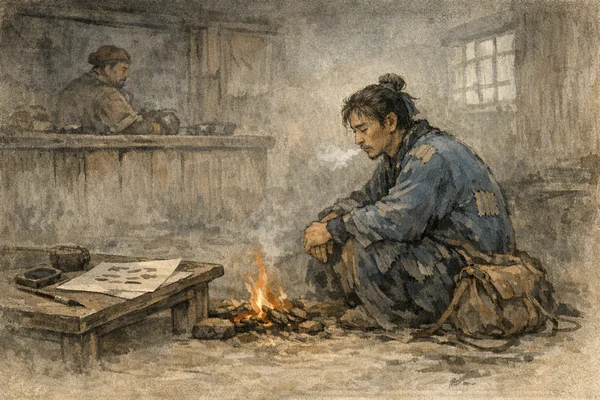 Simply Enduring
Core Meaning
Judgment and image
The Judgment
Success. Perseverance. The great person brings good fortune. No blame. When one has something to say, it is not believed.
The Image
There is no water in the lake: the image of exhaustion. Thus the superior person stakes their life on following their will.
The Six Lines
This list mirrors the figure from top (Sixth) to bottom (First). For interpretation, read from the bottom line upward. Each line shows a different stage of the hexagram's movement.
He is oppressed by creeping vines. He moves uncertainly and says, "Movement brings remorse." If one feels remorse over this and makes a start, good fortune comes. Stuck in tangled thought; self-reproach turning into action breaks free.
His nose and feet are cut off. Oppression at the hands of the man with the purple knee bands. Joy comes softly. It furthers one to make offerings and libations. Severe restraint, but quiet joy within; ritual sustains.
He comes very quietly, oppressed in a golden carriage. Humiliation, but the end is reached. Slow, awkward arrival in honoured station; the destination is made.
A man permits himself to be oppressed by stone, and leans on thorns and thistles. He enters his house and does not see his wife. Misfortune. Compound errors leading to isolation; the worst line of the hexagram.
One is oppressed while at meat and drink. The man with the scarlet knee bands is just coming. It furthers one to offer sacrifice. To set forth brings misfortune. No blame. Troubles in the midst of plenty; honour what you can and do not make bold moves.
One sits oppressed under a bare tree and strays into a gloomy valley. For three years one sees nothing. A long dry spell with no sign; sit it out.
Interpretation and trigrams
Interpretation
The lake has run dry. External resources fail; one is hemmed in by circumstance, and words do not persuade. The figure counsels inner fortitude: a great soul finds the way through depletion. Do not argue or explain; act from conviction and endure.
Trigrams
The Story
A scholar was cast out by his patron and found himself alone in a cold inn in winter, without a coat and without readers. He tried to explain himself to the innkeeper; the innkeeper shrugged. He tried a letter to his old circle; no reply. He sat by a small fire and, for the first time, simply endured without being able to speak. In the spring his writing had a quality it had never had before — tempered, unshowy, indestructible. "Oppression took my voice," he said, "and gave me a real one. The shallow speaker dies in the dry season; the deep one is born there."
Why This Story Fits
The parable is written to make Hexagram 47 visible as lived conduct: The lake has run dry. It echoes the Image's counsel: the superior person stakes their life on following their will. Lower trigram: Water. Upper trigram: Lake. Together they set the story's inner and outer weather.
Quick Meaning
What Hexagram 47 means
Hexagram 47 describes oppression: a time of depletion, confinement, or pressure in which outer resources fail and words carry little force. It appears when the situation cannot be talked out of its constraint. The reading favors inner resolve, endurance, and action from conviction, and warns against wasting strength on explanations that will not be heard.
- It supports perseverance, inner fortitude, and continued fidelity to what is right when outer relief is scarce.
- It favors ritual, quiet movement, and decisions grounded in will rather than in whether others currently believe or applaud you.
- It warns against argument, entanglement, and the exhaustion that comes from trying to persuade people from inside a dry season.
When this hexagram appears
- The situation is genuinely tight. There may be little room, little support, or little immediate response from the outer world.
- Speech has limited power here. Hexagram 47 often appears when explaining more will not solve the problem, and the real task is to endure, simplify, and keep acting from the center.
- What remains is character. The reading favors discovering what still holds when comfort, influence, or recognition have dried up.
How to apply Oppression
In relationships
Do not force belief or demand instant understanding. The reading favors dignity, restraint, and small true actions over strained argument from inside a depleted bond.
In work or decisions
Conserve strength and work from principle. This is a strong time to simplify, endure constraint, and keep faith with the task even when outward conditions are unrewarding.
In personal growth
Let deprivation reveal what is essential. Hexagram 47 supports the will that survives dryness, especially where self-respect depends on remaining true without external confirmation.
Use Hexagram 47 in context
Hexagram 47 FAQ
Does Oppression mean nothing can be done?
No. It means the outer situation is constrained. Action is still possible, but it must come from resolve and proportion rather than from expecting quick relief or persuasion.
Why does the Judgment say that when one has something to say, it is not believed?
Because this is a season in which rhetoric has little force. The hexagram shifts the emphasis from explanation to character, endurance, and the quiet authority of living what is true.
What if Hexagram 47 has changing lines?
Changing lines show whether the oppression is barren and long, hidden inside apparent plenty, worsened by your own mistakes, approached slowly, ritualised into endurance, or broken by remorse that finally becomes movement.
Mobile app
Take the oracle with you
Cast with coins or yarrow, read the daily hexagram, browse all 64 hexagrams, and keep private reading notes on your device.

Available now on the App Store and Google Play.