
I-Ching Hexagram 52
艮 Keeping Still
Also known as Mountain
Hexagram 52, Keeping Still, appears when the answer lies in stopping, settling, and not letting thought or impulse run beyond the situation at hand. The reading favors grounded stillness over restless continuation.
stillness · meditation · stopping
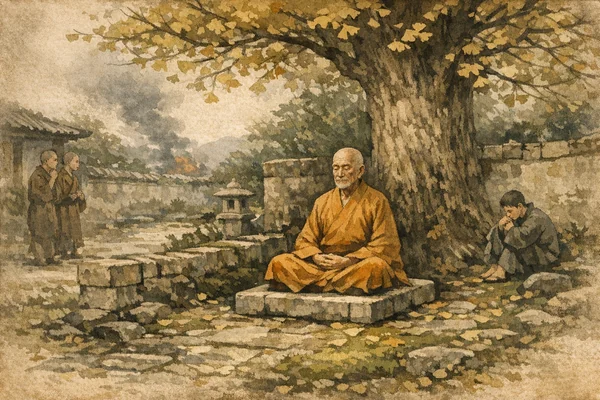 Fourteen-Year Corner
Core Meaning
Judgment and image
The Judgment
Keeping his back still so that he no longer feels his body. He goes into his courtyard and does not see his people. No blame.
The Image
Mountains standing close together: the image of keeping still. Thus the superior person does not permit their thoughts to go beyond their situation.
The Six Lines
This list mirrors the figure from top (Sixth) to bottom (First). For interpretation, read from the bottom line upward. Each line shows a different stage of the hexagram's movement.
Noble-hearted keeping still. Good fortune. The full fruit: a stillness that is not rigidity but capacious calm.
Keeping his jaws still. The words have order. Remorse disappears. Guarded speech; say only what is ordered and true.
Keeping his trunk still. No blame. Stilling the torso — the seat of emotion; mastery of inner impulse.
Keeping his hips still. Making his sacrum stiff. Dangerous. The heart suffocates. Forced rigidity that stops feeling itself; harmful.
Keeping his calves still. He cannot rescue him whom he follows. His heart is not glad. Kept still against one's inclination; reluctant acquiescence.
Keeping his toes still. No blame. Continued perseverance furthers. Stop at the very beginning of the urge.
Interpretation and trigrams
Interpretation
The doubled mountain: stillness. The hexagram is about quieting the wandering mind and anchoring in the present. When the back is still, the whole body settles; when attention is drawn back from every worry, clarity returns. A contemplative counsel.
Trigrams
The Story
A monk sat in the corner of the monastery garden for fourteen years. He did not travel, did not teach, did not argue. New monks laughed at him; old monks walked around him without comment. Once, during a fire, the wind shifted away from his corner and the garden was saved. Once, during a feud, a young novice came and sat near him for an hour, and went away calmed. When the monk died, his successor kept the same corner. "He did nothing," said a visitor. "He did the hardest thing," the abbot replied. "He stayed."
Why This Story Fits
The parable is written to make Hexagram 52 visible as lived conduct: The doubled mountain: stillness. It echoes the Image's counsel: the superior person does not permit their thoughts to go beyond their situation. Lower trigram: Mountain. Upper trigram: Mountain. Together they set the story's inner and outer weather.
Quick Meaning
What Hexagram 52 means
Hexagram 52 describes keeping still: the right stopping of body, speech, and thought so that attention does not run ahead of the real situation. It appears when motion itself has become the problem and clarity can only return through grounded stillness. The reading favors containment, presence, and knowing where to stop without becoming rigid or deadened.
- It supports stillness that restores alignment rather than frozen withdrawal from life.
- It favors stopping at the correct point before impulse, fear, or thought spills too far.
- It warns against forced rigidity, numb repression, or restless mental wandering.
When this hexagram appears
- The movement has gone too far. The question may involve overthinking, overreacting, or continuing past the point where motion is still useful.
- Stopping is the action. Hexagram 52 appears when not acting, not speaking, or not carrying the thought further is the most skillful move available.
- Stillness should be alive, not rigid. The reading does not praise deadening yourself. It points to a calm anchoring that returns you to the present and restores order.
How to apply Keeping Still
In relationships
Pause before speech or reaction runs past what the moment can hold. The reading favors grounded calm, ordered words, and knowing when presence matters more than immediate reply.
In work or decisions
Stop the unnecessary motion. This is a good time to contain scope, settle the mind, and refuse the pressure to keep pushing just because movement feels more productive than stillness.
In personal growth
Practice inhabiting the present limit fully. Hexagram 52 supports meditation, stillness, and the discipline of not letting thought wander beyond what is actually here to be met.
Use Hexagram 52 in context
Hexagram 52 FAQ
Does Keeping Still mean withdrawing from life completely?
No. It means stopping the movement that has become unhelpful, so you can meet life from presence rather than compulsion.
How is this different from repression or emotional shutdown?
Repression hardens and suffocates. Hexagram 52 points to living stillness: a calm, aware stopping that restores proportion and lets clarity return.
What if Hexagram 52 has changing lines?
Changing lines show where stillness is sound, where it is reluctant or forced, where speech must be ordered, or where calm becomes noble-hearted rather than merely frozen.
Mobile app
Take the oracle with you
Cast with coins or yarrow, read the daily hexagram, browse all 64 hexagrams, and keep private reading notes on your device.

Available now on the App Store and Google Play.