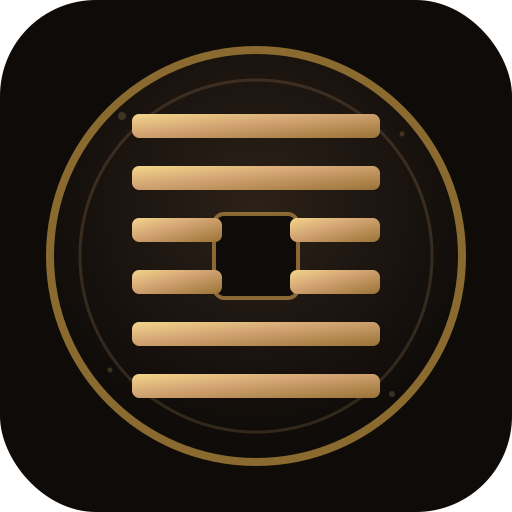
I-Ching Hexagram 50
鼎 The Cauldron
Also known as Vessel of Transformation
Hexagram 50, The Cauldron, appears when the question turns on refinement, cultivation, and what kind of vessel can hold real transformation. The reading favors right positioning, prepared substance, and the slow work that makes nourishment possible.
cauldron · vessel · cultural order
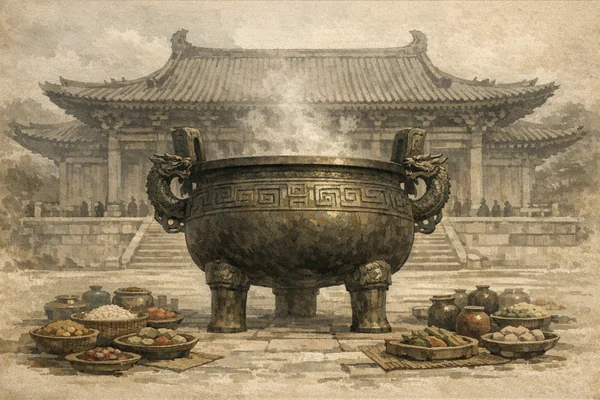 Cauldron At The Center
Core Meaning
Judgment and image
The Judgment
Supreme good fortune. Success.
The Image
Fire over wood: the image of the cauldron. Thus the superior person consolidates their fate by making their position correct.
The Six Lines
This list mirrors the figure from top (Sixth) to bottom (First). For interpretation, read from the bottom line upward. Each line shows a different stage of the hexagram's movement.
The cauldron has rings of jade. Great good fortune. Nothing that would not further. The highest refinement — a consummate instrument.
The cauldron has yellow handles, golden carrying rings. Perseverance furthers. Solid centre; a capable leader, finely balanced.
The legs of the cauldron are broken. The prince's meal is spilled and his person soiled. Misfortune. A task beyond one's strength badly undertaken; public disgrace.
The handle of the cauldron is altered. One is impeded in one's way of life. The fat of the pheasant is not eaten. Once rain falls, remorse is spent. Good fortune comes in the end. A temporary misalignment; adjustment yields nourishment.
There is food in the cauldron. My comrades are envious, but they cannot harm me. Good fortune. Resources are real; do not be drawn into conflict over them.
A cauldron with legs upturned. Furthers removal of stagnating stuff. One takes a concubine for the sake of her son. No blame. Turning over the vessel to clear out what should not remain; a new beginning.
Interpretation and trigrams
Interpretation
After revolution, consolidation — the ritual cauldron in which the new order is cooked into form. The figure concerns refinement, culture, the transformation of raw into nourishing, and the quiet work of setting one's own position rightly so the whole may be founded.
Trigrams
The Story
A great bronze cauldron stood at the center of the new capital, used for the yearly rites. In it, offerings from every province were cooked into a single meal and shared. The cauldron did nothing by itself. But everything the kingdom needed — the rites, the unity, the memory — passed through it. When a faction proposed melting it for weapons, an old minister rose and said: "Destroy the cauldron and you will win one battle and lose the kingdom. That vessel is how we become a people." They kept the cauldron, and found another way to the swords.
Why This Story Fits
The parable is written to make Hexagram 50 visible as lived conduct: After revolution, consolidation — the ritual cauldron in which the new order is cooked into form. It echoes the Image's counsel: the superior person consolidates their fate by making their position correct. Lower trigram: Wind. Upper trigram: Fire. Together they set the story's inner and outer weather.
Quick Meaning
What Hexagram 50 means
Hexagram 50 describes the cauldron: the vessel in which raw material is transformed into nourishment, culture, and form. It appears when the question turns on refinement, preparation, position, and what kind of container can hold real change. The reading favors tending the vessel, clearing out what is stale, and letting value be cooked into something usable and sustaining.
- It supports refinement, cultivation, and transforming rough material into something that can truly nourish.
- It favors right positioning, capable handling, and slow improvement of the vessel as much as the contents.
- It warns against misalignment, spoiled contents, and trying to carry more than the structure can rightly hold.
When this hexagram appears
- The issue is no longer raw force but refinement. Something has to be prepared, cultured, or made fit for human use rather than merely pushed forward.
- The vessel matters. Hexagram 50 often appears when position, leadership, process, or character determine whether good material becomes real nourishment.
- Transformation needs form. The reading favors clearing out what is stale, setting things right, and allowing substance to mature in the correct container.
How to apply The Cauldron
In relationships
Tend the vessel as well as the feeling. The reading favors the habits, agreements, and atmosphere that allow trust and nourishment to deepen over time.
In work or decisions
Improve the process, not only the product. This is a strong time to refine roles, tools, or standards so that good material can become something of lasting use.
In personal growth
Build a life that can hold transformation. Hexagram 50 supports disciplined cultivation, better containers for practice, and the steady work that turns insight into character.
Use Hexagram 50 in context
Hexagram 50 FAQ
Does The Cauldron mainly refer to food or domestic life?
Not mainly. The cauldron is a ritual and cultural image. It points to transformation, refinement, and the kind of vessel that can turn substance into something sustaining and meaningful.
Why does this hexagram focus so much on handles, legs, and the vessel itself?
Because form matters. The reading is not only about what is being prepared but whether the structure carrying it is sound, aligned, and capable.
What if Hexagram 50 has changing lines?
Changing lines show whether the vessel needs clearing, whether resources are being handled well, where alignment is off, or where refinement has reached a more mature and enduring form.
Mobile app
Take the oracle with you
Cast with coins or yarrow, read the daily hexagram, browse all 64 hexagrams, and keep private reading notes on your device.

Available now on the App Store and Google Play.