
I-Ching Hexagram 7
師 The Army
Also known as Discipline
Hexagram 7, The Army, appears when force must be organized rather than merely felt. The reading favors discipline, integrity, clear command, and purposeful action in adversity.
army · discipline · leadership
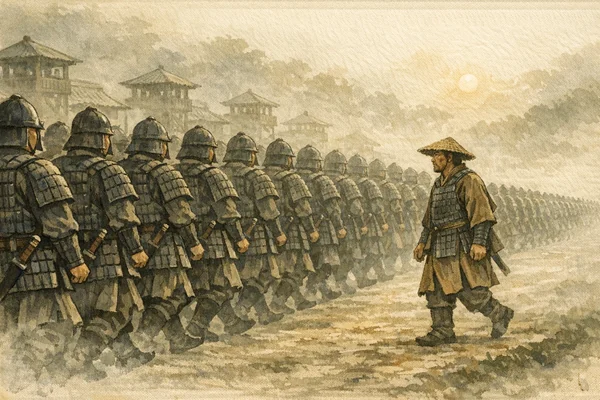 One Body Marching
Core Meaning
Judgment and image
The Judgment
The army needs perseverance and a strong person. Good fortune without blame.
The Image
In the middle of the earth is water: the image of the army. Thus the superior person increases their masses by generosity toward the people.
The Six Lines
This list mirrors the figure from top (Sixth) to bottom (First). For interpretation, read from the bottom line upward. Each line shows a different stage of the hexagram's movement.
The great prince issues commands, founds states, vests families with fiefs. Inferior people should not be employed. After victory, distribute responsibility with discernment; do not reward the unworthy.
There is game in the field. It furthers one to catch it. Without blame. Let the eldest lead the army. The younger transports corpses; then perseverance brings misfortune. Clear lines of authority; mixed command corrupts.
The army retreats. No blame. Strategic withdrawal is not defeat; it preserves the force for the real engagement.
Perchance the army carries corpses in the wagon. Misfortune. An army under poor command is already a graveyard; do not proceed.
In the midst of the army. Good fortune. No blame. The king bestows a triple decoration. Leadership exercised from the centre, not from above.
An army must set forth in proper order. If the order is not good, misfortune threatens. Preparation is the whole art.
Interpretation and trigrams
Interpretation
Organised force. The hexagram addresses leadership in adversity — the marshalling of many under one discipline. Success depends on a leader of integrity, clear purpose, and generosity; without those, numbers only amplify disorder.
Trigrams
The Story
A province rose in revolt, and the emperor summoned a general who had once been a farmer. "How will you raise an army?" they asked. "I will feed them first," he said. He emptied the granaries to their families. He walked among them at night and learned their names. He drilled them, dismissed the cruel, promoted the loyal. When they marched, they marched as one body with one breath, and the revolt fell in three weeks. "An army is not numbers," he told the emperor. "An army is trust wearing armor." Discipline without generosity is only a graveyard on the move.
Why This Story Fits
The parable is written to make Hexagram 7 visible as lived conduct: Organised force. It echoes the Image's counsel: the superior person increases their masses by generosity toward the people. Lower trigram: Water. Upper trigram: Earth. Together they set the story's inner and outer weather.
Quick Meaning
What Hexagram 7 means
Hexagram 7 describes organized force under discipline. It appears when many energies must be gathered under one purpose and held to one line of action. The reading does not praise force by itself. It insists that success depends on integrity, order, and leadership rooted in service rather than ego.
- It supports clear command, disciplined effort, and purposeful coordination.
- It favors preparation, order, and generosity toward the people who must carry the work.
- It warns that mixed authority, poor command, or unworthy leadership turn force into disorder.
When this hexagram appears
- The situation needs organized response. Raw energy or goodwill is not enough. The field now requires structure, roles, and a clear chain of responsibility.
- Leadership is the central issue. Hexagram 7 repeatedly points to the character of the leader: whether authority is exercised from the center, with integrity and generosity, or from ambition and confusion.
- Discipline must serve a real purpose. The reading favors mobilization only when the aim is clear and worthy. Otherwise, numbers merely amplify disorder.
How to apply The Army
In relationships
Bring clear structure to what has become chaotic. Agree on roles, boundaries, and responsibilities instead of letting strain spill into reactive skirmishes. The point is order, not domination.
In work or decisions
Clarify leadership, tighten execution, and make sure the people involved understand the line of action. This is a good time for disciplined coordination, not for improvisation under stress.
In personal growth
Gather scattered will into one disciplined practice. The reading favors self-command that is steady and ethical, not harshness for its own sake.
Use Hexagram 7 in context
Hexagram 7 FAQ
Does The Army always mean literal conflict or war?
No. It often means any situation that requires disciplined collective effort, coordinated response, and clear leadership under pressure.
What makes leadership sound in this hexagram?
Integrity, clarity of purpose, and concern for the people carrying the burden. Hexagram 7 is wary of force that is self-serving, confused, or merely aggressive.
What if Hexagram 7 has changing lines?
Changing lines show where command is sound or failing, where retreat is wiser than advance, or where authority has become mixed and begins to corrupt the whole effort.
Mobile app
Take the oracle with you
Cast with coins or yarrow, read the daily hexagram, browse all 64 hexagrams, and keep private reading notes on your device.

Available now on the App Store and Google Play.