
I-Ching Hexagram 41
損 Decrease
Also known as Giving Up
Willing reduction — giving something up for a greater good. The hexagram praises sincere simplification, modest offerings made with genuine intent, and the inner disciplines that master passion and appetite.
decrease · sacrifice · simplification
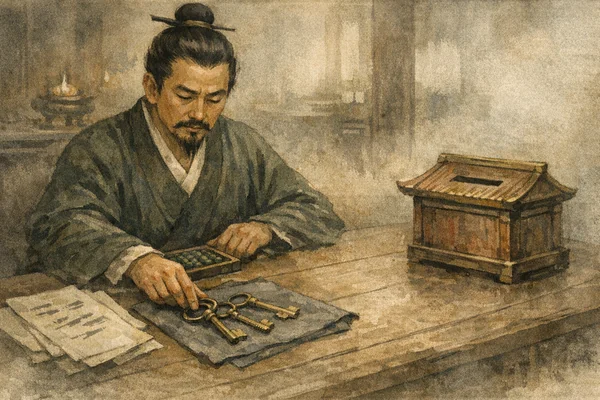 Selling Three Shops
Core Meaning
Judgment and image
The Judgment
Decrease combined with sincerity brings about supreme good fortune without blame. One may be persevering in this. It furthers one to undertake something. How is this to be carried out? Two small bowls may be used for the sacrifice.
The Image
At the foot of the mountain, the lake: the image of decrease. Thus the superior person controls their anger and restrains their instincts.
The Six Lines
This list mirrors the figure from top (Sixth) to bottom (First). For interpretation, read from the bottom line upward. Each line shows a different stage of the hexagram's movement.
If one is increased without depriving others, there is no blame. Perseverance brings good fortune. It furthers one to undertake something. One obtains servants but no longer has a separate home. Growing without taking from others; one grows into a wider responsibility.
Someone does indeed increase him. Ten pairs of tortoises cannot oppose it. Supreme good fortune. An undeniable blessing arrives from above; cannot be refused.
If a person decreases their faults, it makes the other hasten to come and rejoice. No blame. Working on oneself accelerates reconciliation with others.
When three people journey together, their number decreases by one. When one walks alone, he finds a companion. A group too large loses a member; a solitary finds a partner — the right scale matters.
Perseverance furthers. To undertake something brings misfortune. Without decreasing oneself, one is able to bring increase to others. Stay the course; over-giving harms both parties.
Going quickly when one's tasks are finished is without blame. But one must reflect on how much one may decrease others. Finish the job and help the next one, but without draining anyone.
Interpretation and trigrams
Interpretation
Willing reduction — giving something up for a greater good. The hexagram praises sincere simplification, modest offerings made with genuine intent, and the inner disciplines that master passion and appetite. Small, sincere acts outweigh large, empty ones.
Trigrams
The Story
A merchant who had grown rich noticed he was also becoming miserly, sharp with his servants, anxious in his sleep. He sold three of his four shops, gave half the proceeds to his temple, and kept only what he could oversee himself. His income fell. His sleep improved. Competitors laughed, then noticed the loyalty of his remaining staff and the quality of his remaining goods. In ten years he was wealthier than before, and calmer. To decrease is not to lose. It is to release what was carrying you away from yourself, so the essential can breathe again.
Why This Story Fits
The parable is written to make Hexagram 41 visible as lived conduct: Willing reduction — giving something up for a greater good. It echoes the Image's counsel: the superior person controls their anger and restrains their instincts. Lower trigram: Lake. Upper trigram: Mountain. Together they set the story's inner and outer weather.
Quick Meaning
What Hexagram 41 means
Hexagram 41 describes decrease: a willing reduction that serves a greater good. It appears when simplification, sacrifice, or restraint is not a loss for its own sake but the right way to restore proportion and sincerity. The reading favors modest offerings, disciplined reduction, and giving up what weakens the whole, while warning that reduction becomes sterile if it is performative, bitter, or disconnected from real purpose.
- It supports sincere sacrifice, simplification, and restrained action that strengthens what matters most.
- It favors small, honest offerings over large symbolic gestures that conceal vanity or excess.
- It warns against resentful self-denial, theatrical austerity, and reduction that cuts life without restoring meaning.
When this hexagram appears
- Something needs to be reduced. A habit, claim, expenditure, indulgence, or emotional excess may be weakening the larger structure.
- The right sacrifice is measured. Hexagram 41 often appears when a smaller, sincere offering is wiser than a dramatic gesture that costs much but changes little.
- Restraint should strengthen life. The purpose of decrease is not punishment. It is to restore proportion, free energy, and return power to what deserves it.
How to apply Decrease
In relationships
Give up what inflames the bond and keep what nourishes it. The reading favors modest generosity, emotional restraint, and the willingness to reduce ego so the connection can breathe.
In work or decisions
Cut back deliberately. This is a strong time to simplify the plan, reduce waste, and make the smaller sacrifice that preserves long-term strength and credibility.
In personal growth
Remove what scatters you. Hexagram 41 supports disciplined simplicity, sincere practice, and the discovery that less appetite and less noise can yield more steadiness and depth.
Use Hexagram 41 in context
Hexagram 41 FAQ
Does Decrease always mean giving something up?
Yes, but not always in a negative sense. The point is willing reduction that restores proportion and strength, not loss that is meaningless or merely punitive.
Why do two small bowls suffice in the Judgment?
Because sincerity matters more than display. The hexagram teaches that a modest offering, if genuine, can be more fitting and more powerful than an elaborate gesture emptied of truth.
What if Hexagram 41 has changing lines?
Changing lines show whether the decrease is timely, excessive, sincere, reluctant, or already beginning to create the conditions for a healthier increase later.
Mobile app
Take the oracle with you
Cast with coins or yarrow, read the daily hexagram, browse all 64 hexagrams, and keep private reading notes on your device.

Available now on the App Store and Google Play.